book reviews, tales, self-musings, and other randomness

Powered by Blogger.
Showing posts with label Winter Reads. Show all posts

Book Review: Go Ask Alice


Title: Go Ask Alice
Author: Anonymous
Editor: Beatrice Sparks
Genre: Fiction
Publisher: Simon & Schuster
Published: 1971
Pages: 213

“I feel like Alice in Wonderland. Maybe Lewis G. Carroll was on drugs too.”

Since its first publication in 1971, Go Ask Alice has sold more than 5 million copies. This book is a "supposed" authentic portrayal of teenage drug abuse in the late 1960s to early 1970s; it is documented in a series of private diary entries—written in first person—from an unnamed 15 year-old girl (but we’ll refer to her as Alice). The story tackles sensitive topics, such as unwanted sex, underage drinking, and of course the usage of drugs during an era where it was believed certain substances could bring forth peace, acceptance and love to the world. So beware, this story may not be for everyone.

In many respects, this tragic story resonates with the younger crowd because it is written from the perspective of an adolescent. Each page shows a character progression of the protagonist—from her early stages of innocence all the way up to her uphill battle with drug addiction and sobriety. Readers will discover that Alice is a typical teen, faced with typical teenage issues (insecurities, attaining popularity, maintaining an image, etc.). It does a decent job in verbalizing teenage angst and the emotions that most teenagers go through. For instance, she states: “If only parents would listen! If only they would let us talk instead of forever and eternally continuously haring and preaching and nagging…”

The book demonstrates the effects of drugs and its inevitable consequences. Alice addresses the dangers of drugs and addiction in graphic detail, and includes explicit descriptions of the sensations she feels with each drug she uses. Therefore, readers, please do not expect this book to be a fairytale where the heroine overcomes all odds. In the end, she is defeated and succumbs to her addiction.

“I felt great, free, abandoned, a different, improved, perfected specimen of a different, improved, perfected species. It was wild! It was beautiful! It really was.”

As I was conducting research for this book, I came across some articles questioning the book’s authenticity. For years, it’s been portrayed as a non-fiction tale of a teenage drug addict—but over the years, the story’s authorship became a topic of interest to many readers in the late 70’s. Beatrice Sparks, a Mormon and therapist, edited the book and proceeded to publish other books in diary form, centered on the issues that some trouble teens endure (just like this book); thus, it sparked a suspicion. As a result, the book has been criticized for being an anti-drug propaganda and a “literary hoax.”  Regardless, whether true or not, it continues to be praised and is a popular bestseller.

Personally, instead of feeling pity for Alice, I disliked her. In my opinion, for someone to feel the need to use drugs—there has to be a reason to do it (horrible home life, troubles with parents, abuse, etc.), but there wasn’t a legitimate reason for Alice. It all started with her going to a party and accidentally taking LSD. After only taking it once, she vows she wouldn’t do it again—but once her family is settled in a new town and Alice attends a new school, she’s back to taking drugs again. What I’m trying to get at is that there wasn’t a purpose behind her use of drugs. Alice grew up in a loving home, with two supportive (yet, highly naïve) parents, and lived in an upper-middle class lifestyle. What’s Alice’s reason? The reason is never clear.

Another frustrating part about this book is that Alice contradicts herself a lot, for example: “I don’t know why I shouldn’t use drugs, because they’re wild and they’re beautiful and they’re wonderful, but I know I shouldn’t, and I won’t! I won’t ever again. I solemnly promise I will from this day forward live so that everyone I know can be proud of me and so that I can be proud of myself!” Throughout the entire book, Alice is fully aware of the consequences of drug abuse and how it’s negatively affecting her and her family, but she continues this horrid journey—disregarding her life and family.

It just seemed perfectly scripted and plotted. You can tell that there was a motive behind the book, which was just shine light on the dangers of drugs. Although I think the message is clear, the book doesn’t do a good job in convincing readers—like myself—on how true this story is. But one important thing that struck me odd was how the story ended. Towards the end of Alice’s diary, she writes about how she has maintained her commitment to sobriety—there was no mention of her using drugs. In her last diary entry, Alice writes:

“I used to think I would get another diary after you are filled, or even that I would keep a diary or journal through my whole life. But now I don’t think I will. Diaries are great when you’re young.  In fact, you saved my sanity a hundred, thousand, million times. But I think when a person gets older she should be able to discuss her problems and thoughts with other people, instead of just with another part of herself as you have been to me. Don’t you agree? I hope so, for you are my dearest friend and I shall thank you always for sharing my tears and heartaches and my struggles and strifes, and my joys and happiness. It’s all been good in its own special way, I guess.”

Coincidentally, in the epilogue, it states that the “subject of this book” passed away three weeks after her last diary entry; it reported that her parents came home and found “Alice” dead. In my opinion, it just seems like a perfect and tragic ending, or at least it was a perfect segue to the epilogue and to conclude the book.

Would I recommend this book? Yes, to a degree. I think the story is great for young children who are inching closer to their teenage years and who might be curious to explore drugs. But I don’t think it’s a wonderful piece of fiction, nor am I convinced that this story is at all real. I suppose every reader has his or her own conclusions about this book.

x, k

Book Review: Outlander


Title: Outlander
Author: Diana Gabaldon
Genre: Historical Fiction/Romance/Science Fiction
Publisher: Bantam Dell
Published: 1991
Pages: 850


After a long two months, I finally finished reading Outlander—the first book in the Outlander Series by Diana Gabaldon. The novel is drenched in rich historical detail of 18th and 20th century Scotland and England, focusing on the journeys of two main characters: Claire Randall and the beloved Jamie Fraser. This is a historical fiction novel that dabbles in time travel, adventure, and of course, steamy romance.

The year is 1945. World War II (WII) has finally ended. After serving many dedicated years as a combat nurse during the war, Claire is finally reunited with Jack Randall—a passionate historian. Trying to resume their life before the breakout of the war, the couple decides to go on a second honeymoon to Scotland, so Frank could study his family tree. But a peculiar thing happened during Claire’s stay. After Claire and Jack witness a group of “supposed” witches dance around ancient stone circles, Craigh na Dun, Claire decides to go back by herself to the stones to gather plants—but she suddenly encounters a screaming stone that transports her to 18th century Scotland.

Before she knows it, Claire is amidst a small battle between the British and the Scots. As she is whisked away from danger from a bunch of Scotsmen dressed in kilts, she meets an injured (but extremely handsome) Scotsman, Jamie. Claire, a well-trained nurse, uses her skills and knowledge to treat him to the best of her ability. Her talents earned her respect from her fellow Scotsmen, but they suspect that she’s an English spy. As a result, they take Claire with them as their captive to Castle Leoch, where she meets clan chieftain, Colum. After conducting a little investigation in the castle’s library, she discovers that she’s in the year 1743.

After failing numerous times to escape, Jamie and Claire become close, and Claire becomes more accustomed to 18th-century life. But as her bond with Jamie grows more robust, the decision to leave and return to her old life and Jack becomes harder. Claire is faced with returning, leaving behind Jamie, or staying and continuing the new life she has adopted.

The book is narrated by Claire and is divided into seven parts: Part I: Inverness, 1945; Part II: Castle Leoch; Part III: On the Road; Part IV: A Whiff of Brimstone; Part V: Lallybroch; Part VI: The Search; and Part VII: Sanctuary.

In the first part of the story, I must admit that it felt dry, uninteresting, and a bit over-detailed with things that I felt were nonessential. But I didn’t give up, and I’m glad I didn’t; with a little bit of time and patience, the story does get fascinating. I am impressed with the depth of Gabaldon’s knowledge of 18th century Scotland;. However, the book is based on fictional characters and time travel. It is interesting to gain knowledge and insight into the issues occurring during Scotland’s history. Being a history major, I truly appreciate any author who integrates history with his or her storyline.

Readers, you will not be disappointed. You’ll be captivated, engrossed, and entranced in this story about love, hardship, heroism, adventure, and new beginnings. The setting is amazingly well-textured, and Gabaldon’s writing style is fluid, understandable, and eloquent; without a doubt, she is highly imaginative. She also does a superb job in developing her characters—she gives them so much life. And trust me on this, you will fall head-over-heels for the firm, gentle, kind-hearted Jamie Fraser (seriously, who wouldn’t?). On a serious note, you will definitely find yourself eager to read the parts and scenes of Jamie and Claire.

After reading Outlander, I can’t wait to get my hands on the rest of the books in the series.

Overall, it was a great book with a fantastic and unique plot—a book that I would certainly recommend to anyone!

x, k

Currently Reading: A Darker Shade of Magic


I decided to make a post about a book that I am currently reading. It is book that is receiving so much rave and fame in bookish communities, such as in Goodreads, Instagram (Bookstagram) and BookTube. Currently, I am reading a Darker Shade of Magic by V.E. Schwab; it is the first novel of the Shades of Magic series. Recently, the third book to the series was just released this past week, thus stirring the bookish communities into a total frenzy (but in a good way).

A brief synopsis of the book, it is a fantasy novel centered on both good and dark forces of magic, sinister magicians, as well as a cursed and forbidden item. In the book, there are four parallel worlds with four parallel Londons; each London has a different history, time period, language, society, and rulers. Only Antaris, which are powerful and rare magicians that are becoming a scarce breed and who are born with magic in their blood, can travel to and fro from these different worlds. Unfortunately, there are only two surviving Antaris: Kell, who is the protagonist in the story and is from Red London, and Holland, who is from White London.

As mentioned previously, there are four different kinds of Londons. Red London, is a prominent place filled with so much magic, and holds the reputation of being the most powerful London out of all. Then there is Grey London, which is like today’s London, but it takes place when King George III was ruler; it is an ordinary place where magic is scarce. Meanwhile, White London is a land where its people are desperate and fighting to attain or save any magic that is left; the magic and resources are dwindling. Lastly, there is Black London—it is a destroyed world filled with greed for magic.

So far, it is taking awhile for the plot to build up and develop—but it has been an interesting read, thus far. I admire the author’s creativity and her unique imagination that is being demonstrated throughout this book, and surely throughout the rest of her two books in the series as well. Besides, it is always fun to read about magic.

x, Kayla

Book Review: A List of Cages (Five Stars)


A List of Cages by Robin Roe is a beautifully written tale of two boys who rekindle their lost friendship. Even after reading this book, both of the main characters—Adam and Julian—continue to remain in my thoughts. I was left with tears—tears of hope, tears of heartbreak, and tears of absolute love for the book and for the characters in the book.

The story is told through dual narrations of both 14 year-old Julian and his former foster brother, charismatic 18 year-old Adam. Julian lost his parents to a tragic car accident; Julian didn’t have any close relatives to live with at the time, so he was put into foster care. Adam’s mother, Catherine, took Julian in—and both Adam and Catherine, gave the boy a loving home for many long months until his cold and mean uncle—from marriage—came to claim him. After Julian’s uncle, Russell, takes Julian away from Adam and Catherine, Russell ends all communication between Julian and his foster family.

Five years later, Julian enters his freshmen year in high school while Adam enters his senior year. Adam “literally” walks into Julian’s life when he is given a special assignment to escort Julian to his counseling session that Julian has been skipping. Although the boys are thrilled to be reunited, there is a sense of uneasiness. Adam realizes that Julian has changed into a shy, reclusive, timid, fragile, boy who has low self-esteem. The author, Roe, unveils a gripping story of a boy enduring child abuse. But it is also a story about the power of friendship and the brotherly-love that emerges out of it as well.

This has been another great read that I have read in 2017, thus far—it has also become one of my favorite YA novel’s.  As a former counselor, Roe has had professional experience in dealing with children who have been abused. Because of her experiences, it made the book and characters feel as if they were really real. The book stuffed me with so much raw emotion—it was hard to contain my feelings as I was reading this book.  This is Roe’s debut novel—her very first—and I think that she did an impeccable job; her writing is beautiful and so is the story. It is a five star rating all the way.

x, Kayla

Book Review: A Man Called Ove (Five Stars)


A Man Called Ove by Fredrik Backman is a phenomenal and touching tale of a grumpy, stubborn, and prototypical middle-aged man just wanting to be reunited with his deceased wife. It’s comical, relatable and a sad story—which also carries many humanistic elements that enables readers to strongly connect and identify with the main character. This was a book that I truly enjoyed and it has become one of the best reads I have read in 2017, thus far.

Ove is a fifty-nine year-old Swedish man, who has strict principles and a short temper. He spends his days following an austere routine of checking if his entire neighborhood is abiding the association rules and visiting his wife’s, Sonja’s, grave. Ove dislikes many things, and has no shame in pointing them out on the spot. To many people, Ove is staunch and a “bitter” neighbor. Despite what Ove may display on the outside, Ove carries a story of both sadness and hardships.

But since the tragic loss of his one love, Ove has given entirely up on life. Yes, Ove just wants to end it all. Unfortunately and fortunately for Ove, a boisterous family moves into the neighborhood across the street from Ove, and things start to both shake and change Ove’s life completely—but all for the better. With these new neighbors, brings an abundant amount of changes like an unkempt stray cat as a pet and growing friendships that all seem to disrupt his routine—which Ove just hates. But with these new changes, Ove starts to grow a warmer heart and starts to accept the world that he lives in today, which for a while, he was so against.

I cried and I laughed, but I laughed more than I cried. Backman did a wonderful job when writing this story. Every chapter and every line just felt natural. The sarcasm that comes out of Ove and his grumpy façade in general, made this book humorous. I fell in love with old Ove, despite how bad-tempered he is at times. Nothing was dragged on, there wasn’t a dull moment, and every chapter brought in new information about Ove’s past—thus allowing readers to understand the character more in-depth and on an emotional level. There is no other way to explain how great this story was and is—you just have to read it for yourself. I look forward to reading many more of Backman’s stories. He is creative and writes beautifully—I loved how he narrated the tale of Ove and about the many characters’ that seem to interrupt Ove’s life. It is a five-star rating all the way!

Furthermore, I think at some level we all understand the feelings of loss and grief. And for those who have had lost a loved one, we all know the difficulty of carrying on with life without that one person who made life sweet, precious and wonderful. That is what this story is mainly about—it is about a man who can’t bear to live without the one person who made life simply pure, beautiful and magical. To Ove, life didn’t seem worth living without Sonja. Why carry on with life without having that special someone live it with you? But the characters’ that come and interrupt Ove’s life makes him realize that there are some things that are worth living for. In the end, Ove finds a cause and a reason to live.

x, Kayla


Book Review: Rest in the Mourning (3 Stars)


Rest in the Mourning by R.H. Sims, is about self-love and self-care. It is a book of poems that centers on relationships: the feeling of love, heartbreak, deceit, pain, vulnerability, acceptance, healing, and moving on. This bears great similarity to Milk and Honey by Rupi Kaur—and if you liked that book of poems, then you would certainly like Rest in the Mourning.

Basically, it is a torrent of “conscious” thoughts and sentiments. The book takes a feminist approach on female mental and sexual abuse—which expresses the array of emotions that are felt when being with someone who is unworthy of your love. It is poetically deep, moving, touching, and relatable. It shows how the heart is vulnerable to letting go of someone who does not deserve your energy and time.

It motivates females to combat abusive situations and people, and realize that you are worthy of a form of love that is not only healthy, but also raw and emotionally real; it’s about what the soul deserves and needs.

I liked the book, what it stands for, and the message that it conveys to readers in all spectrums—but I am noticing a trend of books that only focus on female abuse and never male abuse. Although the book may speak to a huge crowd of female audience, and may even touch the souls of males, I believe that there needs to be a book that is not only one-sided about certain sensitive topics that are commonly associated with females—but how the problems of vulnerability, abuse, heartbreak, deceit etc., can also apply to men as well. There are not enough discussions about male abuse, because there is a common perception that men are not exposed to the type of sexual or mental abuse that females tend to typically endure, or as often as females. Men used to normally represent power, entitlement, control, and other nonsense bull-crap that led to females to take a stand in society. No one ever wants to believe that males are exposed to sexual exploitation, mental cruelty, and physical maltreatment. It is wrong to think that abuse is a female problem—the main issue is that nobody is willing to address that matter and discuss it in mainstream culture.

This book can speak to the soul, but I hope to find a book that addresses self-love and self-care as a universal problem, not a gender one. I had originally rated it five stars in Goodreads, but I took the time to contemplate about the book further and I realized that it would be worthy of five stars if it included men in the category of being victims as well.  There are people who believe that feminism is about gender equality for both male and females, but I am beginning to realize that it may not be the case anymore—and somehow, this book exemplifies that.

x, Kayla

Book Review: My Name Is Lucy Barton (3 Star Rating)


My Name Is Lucy Barton by Elizabeth Strout, a Pulitzer Prize winning-author of her first book Olive Kittridge, is a story about a writer who grew up poor in rural Illinois and discusses the small trivialities of her own life—both past and present.

Lucy Barton is married and has two daughters—she finds herself ill after removing her appendix. In her unforeseen prolonged hospital stay, her mother comes into town unbeknownst to the protagonist. Lucy hadn’t seen her mother in years; in fact she hadn’t spoken much to her family since her marriage—the family felt she was escaping from her roots in exchange for a new and better life. Both mother and daughter lived separate lives for so many years, but although somewhat strangers now, Lucy was more than happy for her mother’s presence; the protagonist’s relationship with her mother is complex and strained, but there’s a sense of a strong bond between mother and daughter and affection that never seemed to have changed, even though both the character’s have. It records a five-day visit from her mom in the mid-1980s in New York City.

Mainly, her story is about loneliness. Lucy’s past, which has impacted her in many ways, is invincible and incommunicable to her husband, friends, and general peers. The protagonist knows the feeling of hunger, hardship, and living without; therefore, it becomes hard for people to ever relate to someone who had nothing.  Growing up in a small town, she was shunned and looked down upon because of her class. Even when she moved to New York with her husband and started a family, she continues to find people who cannot feel what she felt, nor comprehend her hardships of her past life. Deprived from so much, Lucy had to learn to assimilate to this unfamiliar world that she has always lived in, but didn’t know that it really existed when she was younger.

Although it is about the main character’s loneliness, it is also a story about a mother and daughter—it’s about Lucy’s undying and unquestionable love for her mom, and receiving that love back from her mother. It’s about love, misery, solace, acceptance, family, and fear.

I am a great fan of Elizabeth Strout. This is my second book that I have read from her, and I plan on reading all of her literature, but I wasn’t a true fan of this particular read. I loved the idea and concept of the tale, because it centers on a relationship that is relatable to any mother and to any daughter. Therefore, the book addresses a universal problem and a universal kind of love that allowed me to draw a personal connection to the protagonist’s emotions. But I felt that there was a lack of personal problems. The narrator, Lucy, doesn’t delve into her fallen and broken marriage or talk too deeply of her relationships with others—she mentions people, but doesn’t talk much about them. I felt that there was so much to tell, but the story wasn’t told fully. After finishing it, I felt incomplete with the book’s ending. I wanted to know more about Lucy, more about her life after she left home and moved to New York, and more about her life after her divorce; I knew all about her youth, but I knew nothing of the woman she became from her experiences. Due to that, it was hard to connect to the character, even though I connected to her feelings.

The book was enjoyable, but it wasn’t something I thought was fantastic. I will always continue to admire the author’s talent for connecting readers to ordinary people and problems that take place in ordinary places, because stories like that is what makes fiction almost feel real.

x, Kayla

Book Review: The M-Train (2 Star Rating)


The M-Train, by Patti Smith, is a memoir that is really a book about nothing. That is right, a book a story without a purpose—but some may argue it is a tale of losing and finding oneself. My first indication of this was when Smith opened up the book with a vivid description of a dream she had of an imaginary cowpoke that was quoted saying, “It’s not so easy writing about nothing.” Reading that line made me realize that I was in for an unhappy surprise.

It all begins in 1994, after the loss of her husband and band guitarist Fred Smith, and her brother Todd. The author is living alone in New York City and has a profound interest in cafés, especially for Café ‘Ino, and coffee. In fact, cafés and coffee seem to be one of the most important elements in her memoir; no matter where Smith goes, coffee and cafés seem to always follow her.

Smith writes about her travels to London, Tokyo, Rockaway Beach, and visits the graves of famous writers like Sylvia Plath. What the book mainly expresses is her acceptance and being at peace in her own solitude.

Most book reviewers call this a ballad—a poetic story of losses. Her words and entire prose sound poetic, lyrical, and is also pictorial. But overall, it was not a story that I found myself enjoying.

I have never heard of Patti Smith, but with a quick Google search, I discovered who this unknown famous person was and is. She’s a photographer, poet, and singer/songwriter. Never have I ever heard a song of hers, even when I looked in iTunes and listened to some songs made by her—to see if there would be a hint of recognition—it turned out to be a failure.

The book, to me, was a book about nothingness. Her first memoir, Just Kids, was a bestseller that traces her beginning stages of being a musician and artist. It’s a book that I have yet to read, but I don’t know if I’ll be investing money on anymore Smith’s books. So for right now, I’m feeling a tad hesitant of purchasing a copy of her first memoir, because maybe if I had read that first—it would have given me a better understanding and appreciation of the author. Surprisingly, those who read Just Kids, found this second memoir to be poetically brilliant.

I felt that she was long-winded and the story dragged on and on about nothing! I found myself frustrated with the great temptation of putting down the book and stocking it in my shelf forever, with not a bit of regret of not finishing it. But I didn’t want to be a quitter, so I went through with it and finished it. It was brutal.

It’s hard to write a book review about a book that has no real premise or storyline; therefore, I just had to give it a two-star rating. Others might argue that my rating might be too harsh, but I am an honest person and people always need to hear the truth.

x, Kayla

Book Review: Funny Girl (3 Star Rating)


Funny Girl, by Nick Hornby, is a satirical novel that takes black in 1960s England—most particularly in Blackpool and London. It explores the character of a young 20 something-year-old Barbara Parker, from Blackpool, who idolizes Lucille Ball. Barbara yearns to make a career out of comedy and acting, just like Ball, and forfeits her title and award of Miss. Blackpool of 1964, to move to London to pursue her passions and aspirations in acting.

She moves to London, leaving her father and aunt in Blackpool, and tries to succeed and move ahead—career wise. Luckily for Barbara, her gorgeous looks, big bust, and perfect body, paved the way and contributed to her success and fame in the acting industry. Later, Barbara changes her name to Sophie Straw and becomes the main star in a new sitcom series called, Barbara (and Jim). The main character, in the show, is unintentionally similar to Sophie. Ironically, the character has the same name as Sophie—before she changed her name—and although Barbara in the show is married, the fictional character is also from Blackpool. The show makes the new actress enter into unforeseen prominence and stardom. Sophie quickly finds herself in love with her job and her new famous life; the show allows Sophie to be able to exhibit her talent and her knack for comedy.

This is my first Nick Hornby novel, and on my TBR list I have High Fidelity—which I heard so many good reviews about. I gave this book a go, because I was interested in the plot and main idea of the book. It’s different, it had funny parts in the story that made me laugh out loud, and I love how the author not only focuses on just one character—but with every character in the book. I liked how he explored the personal lives of the producers, writers, actors, and so on and so forth—which made the book intriguing. Although it’s supposed to be a comical and light-hearted novel, it wasn’t extremely funny; some parts were very drawn out that took away from the lines and parts that were supposed to make readers laugh.

The book is a tribute to the golden age of light entertainment, which is why Lucille Ball became a key part of the book and a main inspiration to Sophie; Ball was a talented, honest, and funny actress that redefined sitcom humor and brought laughter to many homes in America during the 1950s.  Everything mentioned in the book is based on a broad factual past of light entertainment, politics in England, and BBC programming. Hornby’s goal was to only pay a tribute to the tone and style of television era, but to also vividly illustrate it.

I most particularly liked how the last chapter of the book flashes forward to the present time, and we get to know exactly what the character’s have been up to since their rise to fame fifty years later. But overall, it wasn’t a novel to brag about or to even greatly praise. I rated it three stars because I thought the plot was interesting, and as I mentioned previously before, Hornby is not only focusing on Sophie’s journey to fame and success—but also everyone else involved in the creation of the sitcom show. The idea and main objective of the book was enough to make me like the book, but the overall content in the book didn’t make me fall in love with the story.

x, Kayla

Book Review: Drinking at the Movies (4 Star Rating)


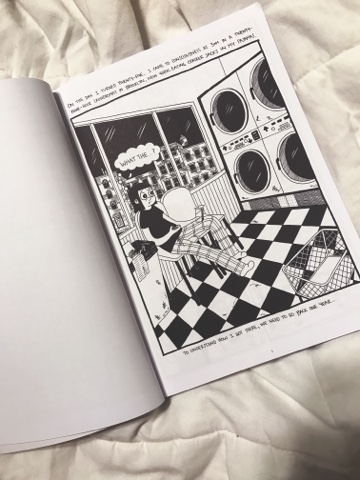
It has been a few weeks since I last blogged! Being that I was away for some time, I didn't have much time to do some extensive reading, but I did finish at least one book. Recently, as a Christmas gift, I got a graphic novel. The graphic novel, which is called Drinking at the Movies by Julia Wertz, is an actual memoir of the author's journey to familiarizing herself in the unfamiliar streets of New York. You may think it's just another sappy and "coming of age" tale of a girl moving to a new town, not knowing anything, and trying to figure herself out--well yes, that it is partly true--but it's very unique, because the memoir is not just telling the story through just words only, but through comic strips.

I am positively sure that there are many memoirs out there that are conveyed through picture or comic strips, but this is my first graphic novel that I have ever read, so I am quite impressed. My goal is to try and diversify my reading, by reading other kinds of cool and different book genres. Since this is my first graphic novel, I thoroughly enjoyed this read, and I found myself finishing it in an entire day. 

The book was published seven years ago and is a follow up of Wertz’s previous graphic novels: The Fart Party Vol. 1 and 2 (which I plan on reading eventually). According to the author, the book is about how she was a “f***** moron” when she first moved to New York City. 

Originally, Wertz is from San Francisco and impulsively decided to move to Brooklyn when life at her hometown began going downhill—career wise and with her personal life. It chronicles her life from 2007-2008, best described as her “adjustment period.” Basically, it is about a poor, whiskey-addict, lost, naïve, confused, irresponsible, and a desperate female who consistently makes whimsical and poor decisions. It’s about one’s ability to grow up, in which the author evidently failed at doing so until the end of the novel. 

There’s a lot of satire, which mostly centers on self-deprecating humor, and basically pokes fun of her drinking problems and poor choices, thus leading to a ton of fun and realistic anecdotes. Her amusing tales of her many attempts at keeping a steady job, in which she ultimately and triumphantly failed at doing so, and her inability to grow-up and be an adult, is best described as like a big carnival ride that we all hope to never go on. Wertz’s humor is obscene and she has no shame in sharing her failures at adulting and conforming in society; I truly admire her ability to not use a filter—she has no shame in exposing every part of her mistakes, no matter how bad it looks. Her memoir is real, raw and is certainly relatable to a wide mass of young and lost 20-something-year-olds who are still trying to figure out how to cope with the daunting “real world.” 

Additionally, the author’s art is fantastic! Readers will find themselves not only in love with the story and Wertz’s dark humor, but will also be in awe of her art and beautiful talent. 

Comic books have never been my kind of thing, but this graphic novel is a superb read! I definitely recommend it to anyone and everyone—especially those who have never read graphic novels before. Wertz definitely knows how to entertain and captivate readers. 


x, Kayla


Book Review: Heartless (3 Star Rating)

Received Heartless from Owlcrate--it is a YA book monthly book subscription box. It came with the book, Carroll's original story, and other bookish goods. 


The story Heartless, by Marissa Meyer, is a part of the Lunar Chronicles—which are a series of books with modern adaptation and whimsical spinoffs of our favorite classic fairytale stories, like Cinderella called Cinder, Snow White called Winter, and so on and so forth.

It tells the tale of the untold story of the Queen of Hearts—inspired by the fictional character in Lewis Carroll’s story Alice’s Adventures in Wonderland—and the events that led to her wretched transformation. The story begins with introducing the main character as a regular teenage girl, named Lady Catherine, or also known as Cath to close friends and family. Cath is filled with an abundance of innocence, hope, has a talent for baking scrumptious pastries, and desires to pursue her dream of starting a bakery with her close friend and maid, Mary Ann.

The unwise King of Hearts and her parents believe that they know what is best for young Catherine. Her mother’s only goal in life is to watch her daughter wed the King of Hearts—honor and reputation are very important to Catherine’s mother. Catherine’s parents also disapprove of her unladylike ambition and passion for baking pastries.

In the kingdom of Hearts, Catherine is the most desired lady and has captivated the king, as well as the new court joker, Jest. But when a marriage proposal from the King of Hearts surfaces, in which holds Catherine’s destiny and fate, she begins to find herself conflicted. She wants to honor her reputation and parents, even if marrying the king may make her eternally unhappy—since she does not love him, or to follow her heart and live a blissful life with Jest. Catherine understands the consequences of her actions and choice, but finds herself enter into a secret courtship, with the mysterious Jest.

Not only is Catherine conflicted with personal problems, but also the kingdom is confronted with the reality of a legendary monster called the Jabberwock, in which has invaded the kingdom and taken many innocent souls for sustenance.

The main character is strong-willed and is greatly determined to control her own fate and destiny, regardless if this Wonderland she lives in is filled with magic and dark creatures. Unfortunately for her, Catherine finds herself unable to choose her own fate, and because of that, she turns into the infamous queen that we have all came to know from Carroll’s story.

Researching about the book and the author, I have attained a newfound respect for Meyer’s creative work. I love how she takes classic and timeless fairytales, and turns them into something more interesting, by exploring new angles with them. Also, I’ve come to admire her inspiration and literary references in Heartless, as well as for the characters, like with the character Raven. The Raven is Jest’s loyal friend, companion, and is the Rook to the White Queen of Chess (once you read the story, you’ll understand). Apparently, the Raven was inspired by Edgar Allen Poe’s story, called The Raven (as you might’ve already guessed). According to the author, Carroll also used literary references in his stories, so Meyer felt somewhat compelled to do it for her book too. Of course the Joker card, which is considered to be the most useless card in a deck of playing cards, inspired the creation of Jest—although the card is useless, it is always there (as you will come to learn in the story).

I find this particular story to be unique, because it doesn’t end with a sappy happy ending—even though that I was clinging to the hope that it would. Readers will fall in love with Catherine, pity her, and will ultimately understand her. Although we all know the inevitable, we can emphasize with Catherine through this untold tale and can also see ourselves being friends with if she was a real person. She was a happy and normal girl; events that played in her life took a toll on her, therefore, leading her to be the mean and angry Queen of Hearts, that loves to say her famous four words, “Off with his head.”

The reason why I gave it three stars was because in the beginning of the book—it sounded so childish. I understand it is based on a fairytale story that was made for children, but this a YA novel; therefore, it shouldn’t necessarily contain a hint of childishness. I don’t know if “childish” is the proper word to describe what I am trying to convey; maybe I felt that certain parts of the book felt ridiculous. Usually, I am the type of person to read more serious books and not necessarily YA novels. It was a new and different kind of read for me, which I did admire and appreciate, I just didn’t entirely love it.

In the middle, and of course towards the end, the story made me feel a huge array of different emotions. There was excitement, thrill, anticipation, agony, and so many more. Ultimately, I felt disappointed by the very end, because like I said before—I was really hoping that Meyer would change the character’s fate, but of course it didn’t turn out that way. Although I love to read books with happy and inevitable endings, I truly liked the fact that we as readers knew all along that it was not going to end with a “happily ever after” ending (I feel like I sound a tad redundant).

I would recommend this read to those who love their classic fairytales and who want to revisit their favorite childhood stories, but with a new and modern twist. It is a good story, but it’s not a story for me.

x, Kayla